

Medicaid, Filial Law and Family

Filial responsibility laws date back to 17th century English law requiring children to financially support their parents when they couldn't support themselves.
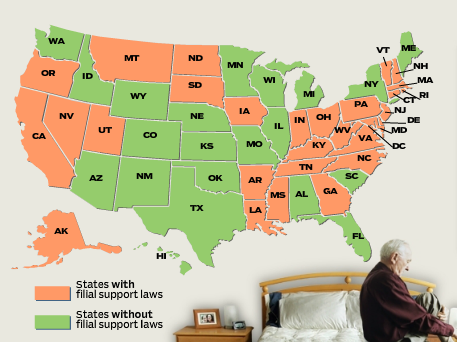
Because of age, or maybe an illness like Alzheimer's, millions of Americans are no longer able to take care of themselves.
Spending one's own money for care can wipe out a life's savings in a short time. It could be someone in your family.
What happens when the money runs out? Out of love, you may feel a moral obligation to help. In some states, however, you may be legally responsible for paying your parents' long-term care.
These are states with filial laws and long term care insurance will provide protection for you and your family.
A recent story brings this law into the spotlight: Son Hit With Mother's $93,000 Nursing Home Bill (pdf)
Long-term care is not just a personal financial issue — it is a family issue. When a parent or spouse needs care and has not planned for it, the burden falls on family members, both emotionally and financially.
What does care cost today?
According to the Cost of Care Survey, the national median costs are:
- Private nursing home room: $127,750 per year
- Assisted living: $70,800 per year
- Home health aide: $77,792 per year
Medicaid and spend-down Many families assume Medicaid will cover long-term care costs. It can — but only after a person has spent down nearly all of their assets. In most states the Medicaid asset limit for a single person is just $2,000 in most states. Everything above that must be spent on care before Medicaid steps in. A Partnership qualified policy protects assets dollar-for-dollar equal to the benefits paid, shielding your family's inheritance.
Filial responsibility laws More than 25 states have filial responsibility laws that can require adult children to pay for a parent's unpaid care costs. While enforcement varies by state, the legal exposure is real. Long-term care insurance removes this risk by ensuring care costs are covered by the policy rather than left as unpaid debt.
The family caregiver burden The majority of long-term care in the United States is provided by unpaid family members — typically adult daughters or daughters-in-law. The physical, emotional, and financial toll of caregiving is significant. A long-term care insurance policy provides access to professional care coordinators and paid caregivers, reducing the burden on family members and preserving relationships.
Get a quote and start protecting your family today.

Elder-Care Costs Deplete Savings of a Generation
By Jane Gross
New York Times
To care for her ailing 97-year-old father over the past three years, Elizabeth Rodriguez, a vice president at the Federal Reserve Bank in New York, has borrowed against her 401(k) retirement plan, sold her house on Staten Island and depleted nearly 20 years of savings.
The money has gone to lawyers’ fees ($50,000) to win a contested guardianship. It has gone for home-care equipment like the mattress for his hospital bed (about $3,000 in all) and for a food service to deliver meals ($400 a month).
It has gone for a two-bedroom rental apartment big enough for herself, her dad and a home aide ($1,600 a month more than a one-bedroom apartment in the same building), and for a wheelchair-accessible van to get him to doctors’ appointments ($330 a trip).
Asked to tally the costs, Ms. Rodriguez, 58, said she had no idea how much she was spending. “A shower chair, body cream with no alcohol, new shoes,” she said. “You don’t stop and calculate. You just buy what you have to buy.”
To read the complete article go to NY Times
| The majority of home care is provided by unpaid family members. Some long term care insurance companies offer a "cash" option that would allow the policyowner to pay a family member or friend for care. Ask us about these plans. |
With experience of over 25 years in long term care planning our experts work with the largest and most financially secure insurance companies to make sure your future is protected.

Long Term Care is a family affair.
The majority of caregivers are family members.